
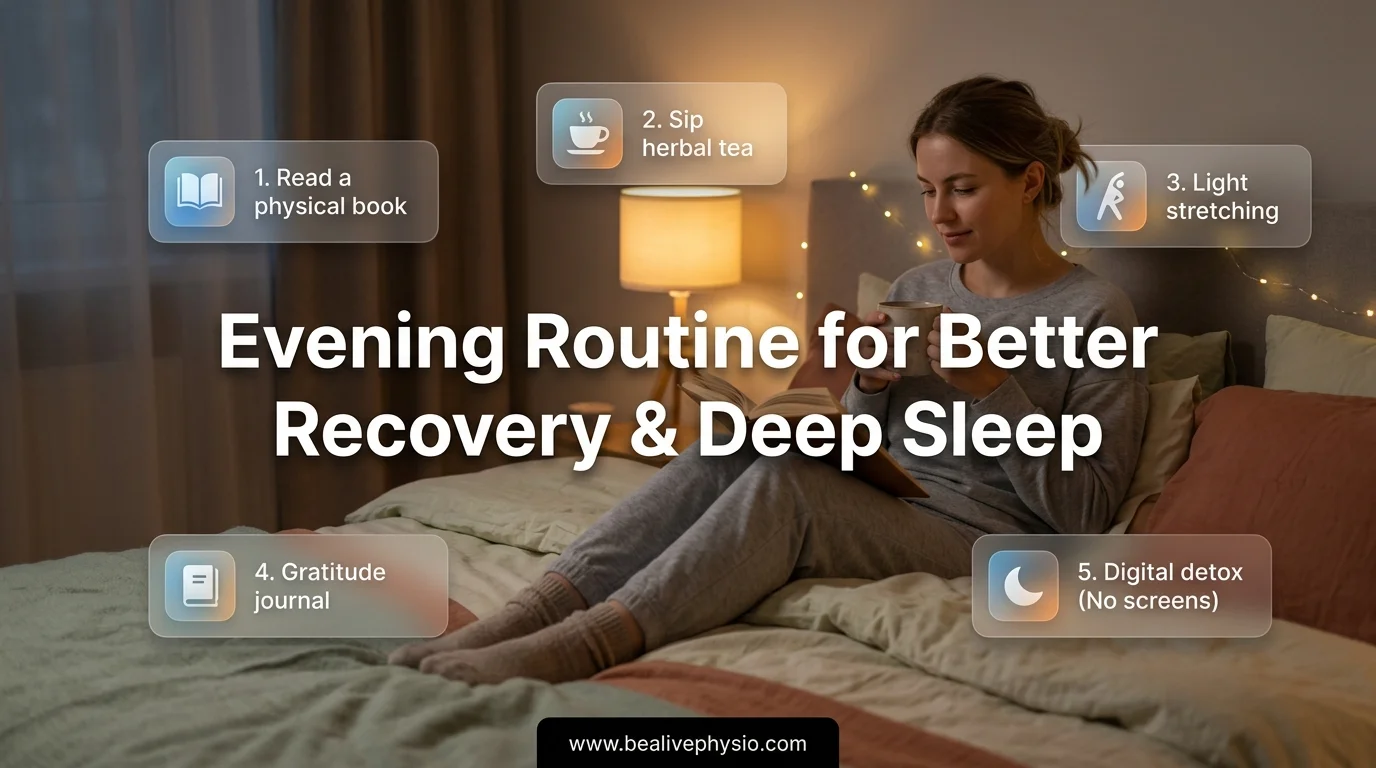
Most people focus heavily on their morning routine, yet the real foundation for better health, improved recovery, and calm mental focus is built at night. My clients over the years—busy professionals, parents, athletes—often struggle not with mornings, but with unstructured evenings. They work late, eat randomly, scroll endlessly, and then wonder why their body feels tense and their brain won’t switch off.
When I started helping people build science-backed evening routines, the results were surprisingly fast:
- deeper sleep
- less next-day fatigue
- better muscle recovery
- reduced anxiety
- improved morning focus
This guide is my best breakdown of practical, realistic, experience-based evening routines that normal people (not monks) can follow. No perfection required.
Why Your Evening Routine Determines Tomorrow’s Energy
Your nervous system doesn’t magically relax at bedtime. It needs gradual off-ramping, much like dimming the lights instead of flipping a switch.
Research from the National Institutes of Health and Sleep Foundation shows that:
- A predictable pre-sleep pattern improves sleep latency (falling asleep faster)
- Lower nighttime cortisol supports muscle repair
- Reduced blue light enhances melatonin release
- Evening stress levels strongly affect sleep quality
This isn’t about “sleep hacks.” It’s about giving your body the environment it needs to repair and reset.
Building a Real Evening Routine That Works in Real Life
Below is a full routine based on what I’ve seen work for hundreds of clients, and what I personally use.
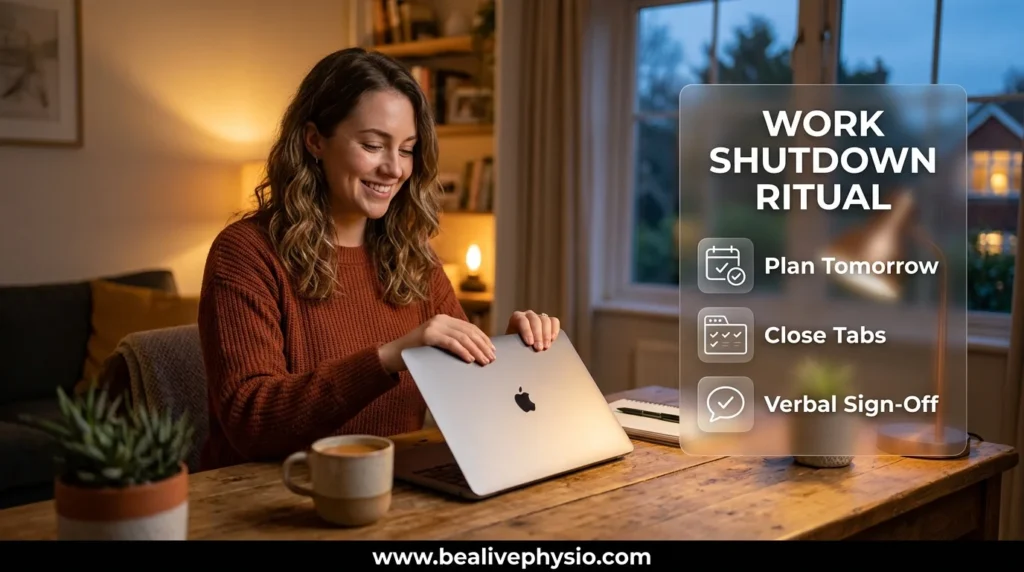
Step 1 — The “Work Shutdown” Ritual (60–90 minutes before dinner)
Why It Matters
Most people stop working physically but never shut down mentally. Tasks keep looping in the brain, spiking cortisol. You can’t recover if your brain thinks you’re still “on-duty.”
What To Do
You only need 3–5 minutes.
1. Write tomorrow’s must-do list (3 items max).
Use any device or app you already use—Google Keep, Notion, or a standard notebook.
2. Close all tabs on your laptop.
A cluttered digital workspace equals a cluttered mind.
3. Say an actual sentence out loud:
“Work is done for today. It can continue tomorrow.”
Cognitive behavioral psychologists often use verbal closure to signal the end of a mental task.
Common Mistake
People try to mix work and relaxation, like checking email while half-watching a show. This keeps the brain in “semi-alert mode,” making real recovery impossible.
Step 2 — Eat a Calming Dinner (Avoid Late, Heavy Meals)
Why It Matters
Your body can’t prioritize sleep quality if it’s still digesting a heavy meal at 10:30 PM.
A few guidelines based on results from clients:
What Helps
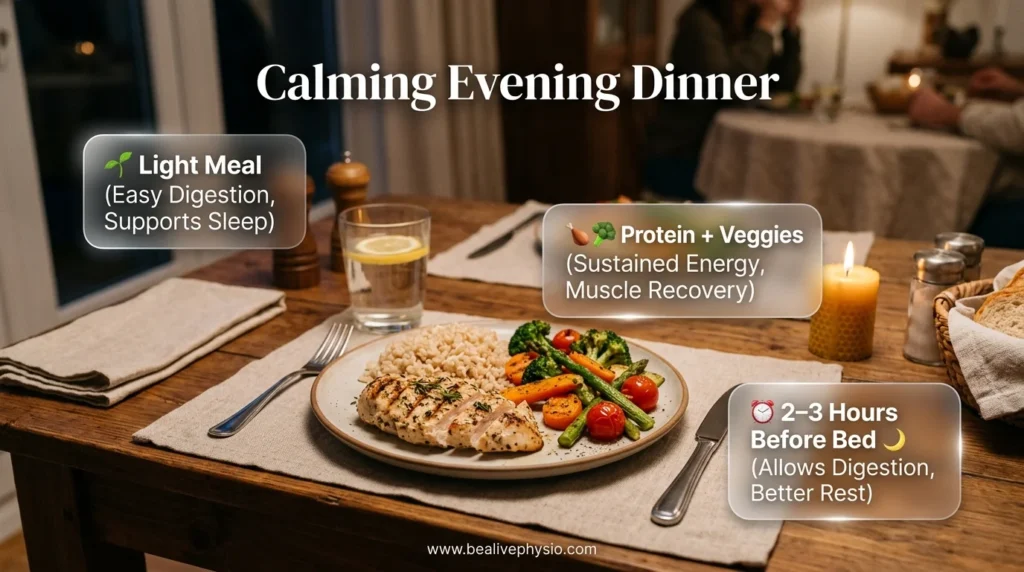
- Finish dinner 2–3 hours before bed
- Include protein + veggies + slow carbs
- Avoid spicy and greasy foods (they often trigger nighttime reflux)
- Add magnesium-rich foods: spinach, almonds, yogurt
Real-World Examples
Good: grilled chicken, rice, steamed vegetables
Bad: biryani + soft drink at 9:45 PM (you’ll be awake digesting until midnight)
Mistake People Make
Trying to eat “super healthy” but choosing foods that are hard to digest at night. Simple meals work better.
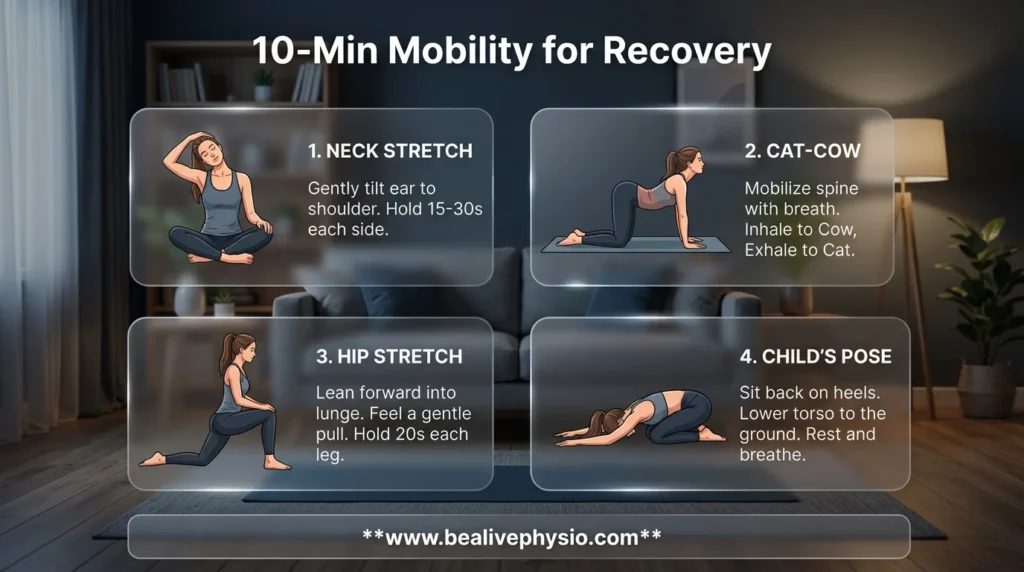
Step 3 — 10-Minute Mobility or Stretching Routine
This is the part that many clients said changed their lives.
You don’t need a yoga mat or Instagram-level flexibility—just 10 minutes.
Benefits
- reduces muscle tightness from sitting
- helps athletes recover faster
- signals the nervous system to wind down
- reduces the “wired tired” feeling
Quick Routine (No Equipment Needed)
- Neck stretches – 1 min
- Shoulder rolls – 1 min
- Cat–cow – 1 min
- Hip flexor stretch – 2 min
- Hamstring stretch – 2 min
- Child’s pose – 2 min
If you want tech support, apps like Pliability, Down Dog Yoga, or Mobility by Nike offer guided routines.
Step 4 — The Digital Sunset (45 minutes before bed)
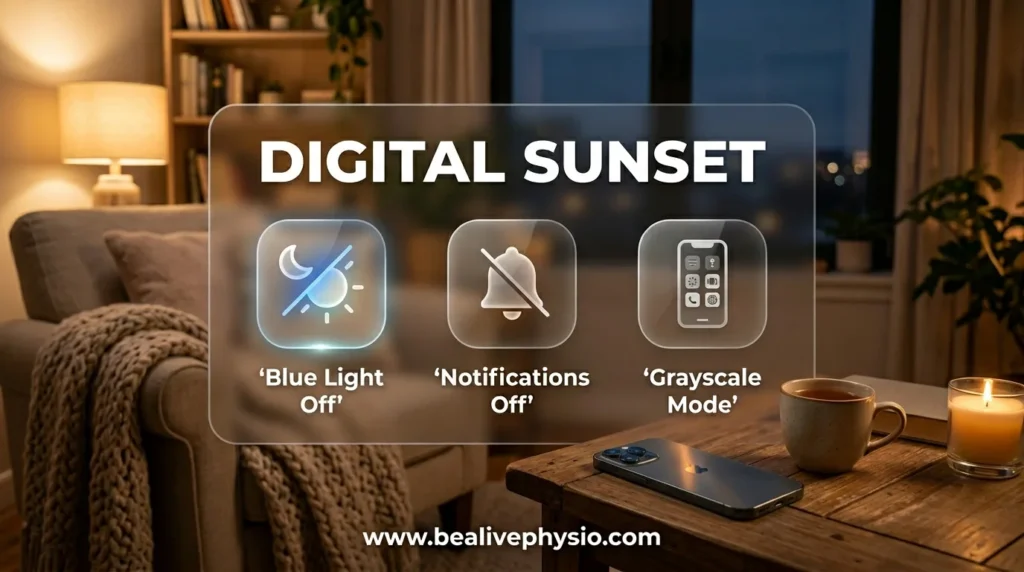
If I had to pick ONE game-changing habit, this is it.
What It Means
You stop exposing your eyes to stimulating screens or content.
Why It Works
Blue light suppresses melatonin.
Scrolling stimulates the brain.
Notifications create micro-stress spikes.
Practical Options
- Switch your phone to Grayscale Mode (iOS & Android have it)
- Use Night Shift or Blue Light Filter
- Put your phone in another room
- Use a Kindle or audiobook instead
Mistake Most People Make
They think, “I only scrolled for 10 minutes.”
In reality, it took 45 minutes and created stress and comparison thoughts right before bed.
Step 5 — Hot Shower + Cool Room Combo

This is supported by thermoregulation research: warm showers dilate blood vessels, causing your core temperature to drop afterward and helping you sleep.
My Recommended Routine
- Warm shower for 5–8 minutes
- Keep bedroom cool: 18–21°C (65–70°F)
- Use a breathable bedsheet (cotton or bamboo)
Tools That Help
- Budget: small table fan
- Premium: Dyson Cool or any smart AC set to sleep mode
- Optional: a weighted blanket if you’re anxious
Mistake
Sleeping in a hot room. It raises your heart rate and reduces deep sleep.
Step 6 — Stress Offloading Practice (5–7 minutes)
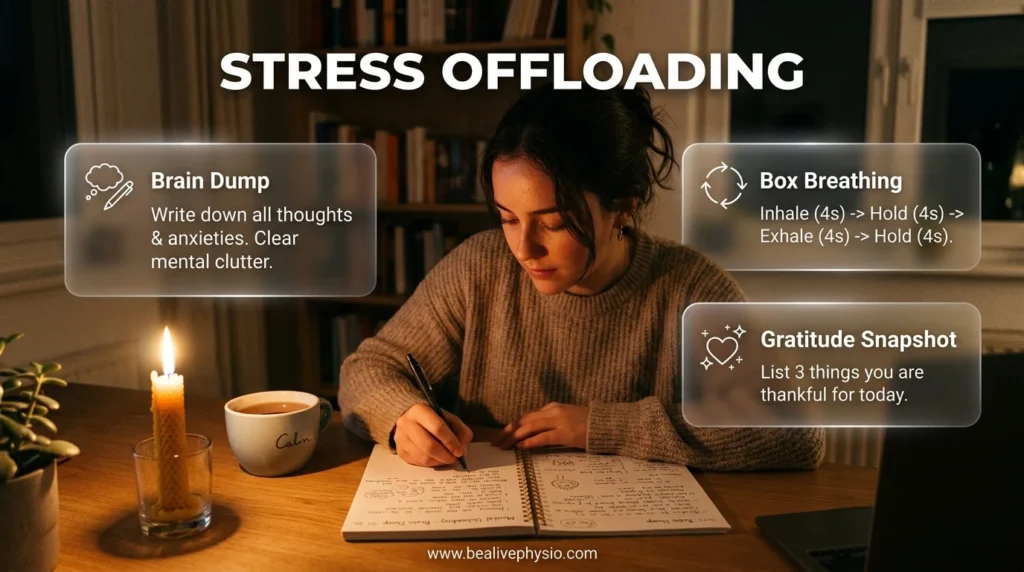
You don’t need a meditation retreat. You need a simple offloading method.
Method A — Brain Dump
Write down anything on your mind. Don’t organize. Just unload.
Method B — Box Breathing
Inhale 4
Hold 4
Exhale 4
Hold 4
Navy SEALs use this to reduce stress.
Method C — Gratitude Snapshot (not journaling)
Write one sentence:
“The best part of today was ____.”
Mistake
Using meditation apps that are too complex or require long sessions.
Your evening routine should be calming, not another task.
Step 7 — Build a Bedtime Identity Cue
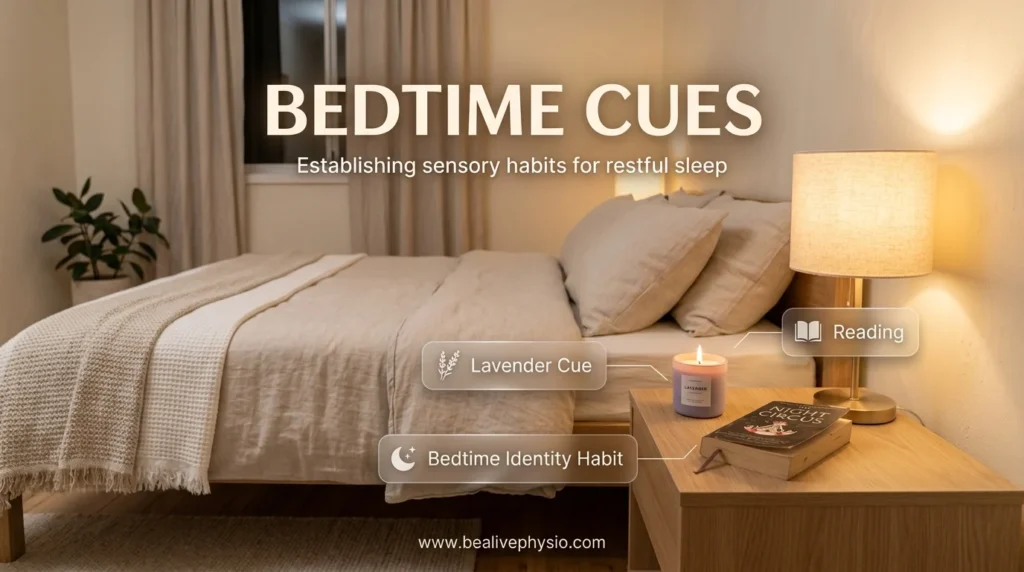
Your brain loves associations. If you always do one small thing before bed, your body starts recognizing it as a “sleep cue.”
Examples:
- lighting a small bedside lamp
- applying light moisturizer
- reading 3 pages of a physical book
- setting your water bottle on your nightstand
- playing soft ambient music
Real Client Example
One of my athletes found that lighting a small lavender candle 15 minutes before bed helped her sleep faster because her brain learned: lavender = bedtime.
Step 8 — Create a Sleep-Proof Bedroom Setup
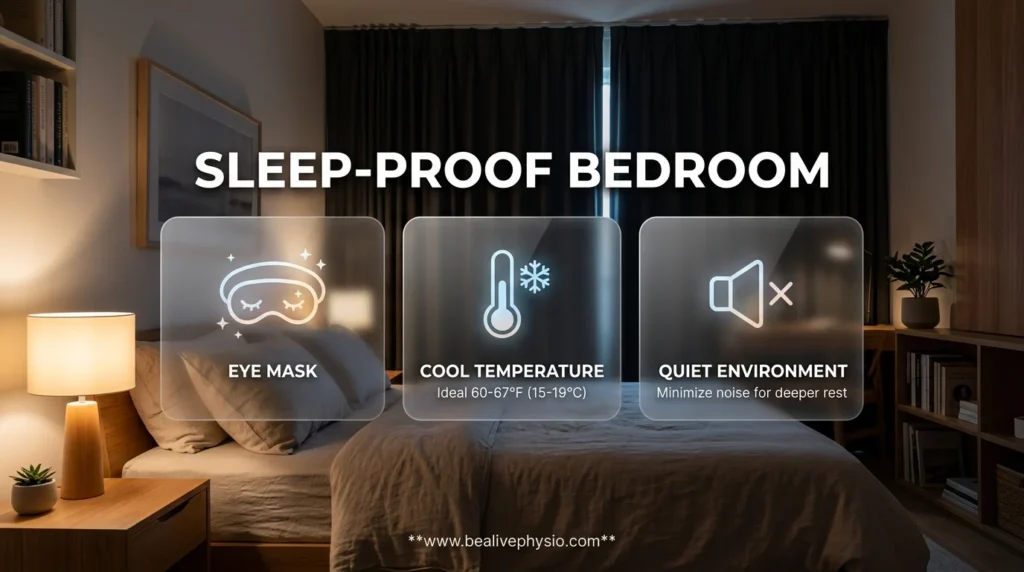
You don’t need expensive gadgets. Start simple.
Essentials
- blackout curtains OR eye mask
- comfortable pillow (don’t keep a 5-year-old pillow)
- No TV in the bedroom
- low-light bedside lamp
Optional Technology
- White noise machine
- Smart bulbs that dim automatically (Philips Hue, Mi Smart)
- Fitness trackers (Oura, Garmin, Fitbit) to learn patterns
Mistake
Using your bed for work, eating, scrolling, or planning.
Your brain should associate the bed with sleep, nothing else.
A Sample Evening Routine (Realistic, Not Perfectionist)
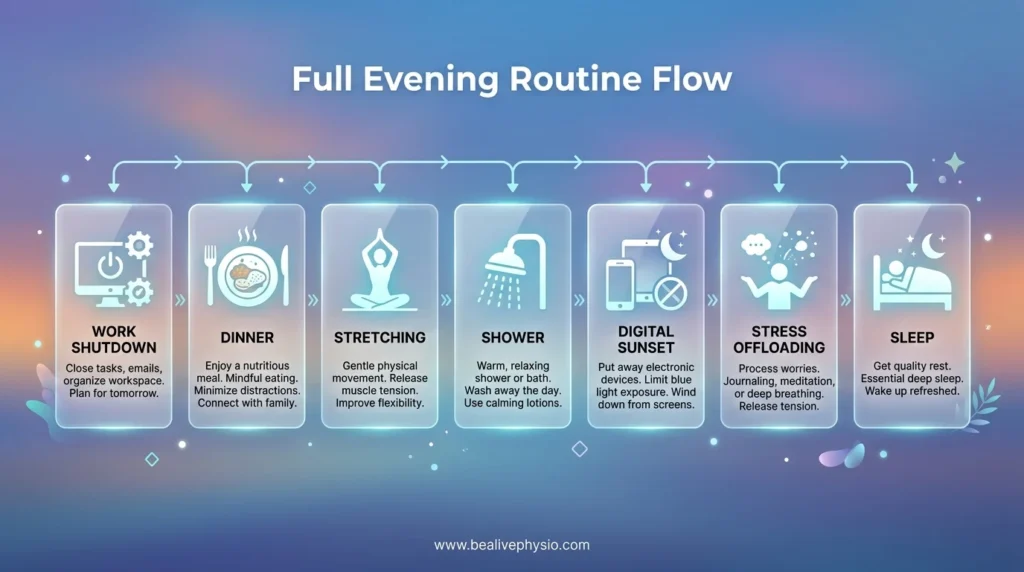
Here’s something even busy people can follow:
- 6:30 PM — End work, write tomorrow’s priorities
- 7:00 PM — Dinner
- 8:00 PM — Light stretching
- 8:30 PM — Shower
- 9:00 PM — Digital sunset
- 9:15 PM — Brain dump + paperback book
- 9:40 PM — Bedroom setup (lights, fan, water)
- 10:00 PM — Sleep
Adjust time according to your lifestyle.
Mistakes That Destroy Evening Recovery
1. Eating too late
Digestion delays melatonin release.
2. Intense workouts right before bed
Your heart rate stays high for hours.
3. Drinking caffeine after 5 PM
Even if you “don’t feel it,” it affects deep sleep.
4. Falling asleep with the TV playing
Your brain still processes background audio.
5. Using the bedroom as a multitasking space
Everything becomes mentally noisy.
Frequently Asked Questions (FAQs)
Most people see benefits with 30–45 minutes of intentional wind-down time.
Yes, but limit stimulating apps. Use grayscale mode or an audiobook.
Warm milk, chamomile tea, or magnesium-rich drinks. Avoid sugar and caffeine.
Reduce light exposure, keep the room cool, and practice 4-7-8 or box breathing.
Optional. Trackers help identify patterns, but aren’t mandatory for good sleep.
Anything after 5 PM can disrupt nighttime sleep cycles.
High-intensity training does. Light stretching or a walk is fine.
Final Thought
Evening routines aren’t about perfection—they’re about consistency. A calm evening becomes a productive morning. A relaxed nervous system becomes a healthier body. All you need is a simple structure that fits your life, not someone else’s ideal schedule. Start with one habit tonight; your body will thank you tomorrow.