

Setbacks used to derail me completely.
A missed workout turned into a skipped week. One bad food choice turned into a full-blown binge. A failed project made me question whether I was even capable. If you’ve ever felt that spiral, you’re not alone—and more importantly, you’re not stuck.
What changed things for me wasn’t more motivation. It was learning how to reframe setbacks in personal development and turn them into fuel instead of friction.
This article isn’t theory-heavy. It’s based on real patterns I’ve seen—in fitness, work, and daily habits—and how small mental shifts can lead to massive long-term consistency.
Why Most People Stay Stuck After a Setback

Before fixing the problem, it helps to understand it.
Most people don’t fail because of the setback itself. They fail because of how they interpret it.
Common Patterns I’ve Seen (and Lived Through)
- “I messed up, so I might as well quit.”
- “I’ll restart next Monday.”
- “I always do this… I lack discipline.”
This is where failure psychology plays a role. Your brain tries to protect your identity. When something goes wrong, it looks for a story—and usually picks a negative one.
That’s why cognitive reframing is powerful. It helps you rewrite the meaning of the event.
What Does It Mean to Reframe a Setback?

Reframing doesn’t mean pretending everything is fine. It means choosing a more useful interpretation.
Instead of:
“I failed.”
You shift to:
“This showed me what doesn’t work.”
Instead of:
“I lost progress.”
You think:
“I found a weak spot I can fix.”
That shift alone is the foundation of a growth mindset.
Real Example: How I Turned a Fitness Slip-Up into Momentum
A few months ago, I broke a 30-day workout streak. Not just one day—I missed three in a row.
Old me would’ve quit.
Instead, I asked one simple question:
What caused this?
Here’s what I found:
- My schedule changed
- Work stress increased
- My workout plan was too rigid
What I Did Next (Step-by-Step)
- Reduced friction
I switched from 60-minute workouts to 25-minute sessions. - Changed the goal
From “perfect streak” → “show up 4 times a week.” - Tracked progress differently
I used a simple habit tracker (Google Sheets + reminders) - Removed guilt loops
No punishment workouts. No overcompensating.
Within two weeks, I was more consistent than before.
That’s how you turn obstacles into opportunities for growth.
How to Bounce Back After a Setback (Step-by-Step Framework)
This is the exact system I now use across fitness, work, and habits.
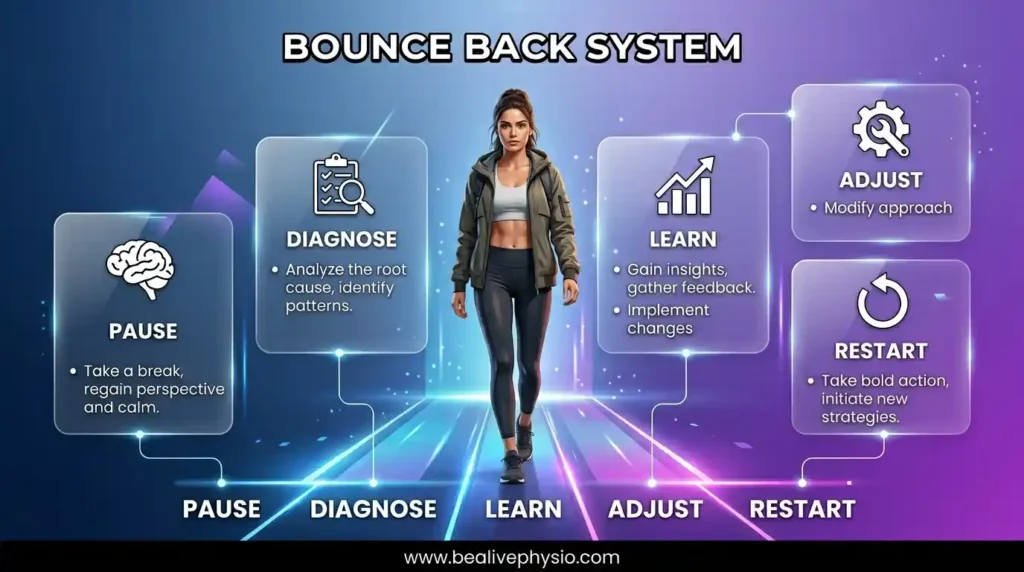
Step 1: Pause the Emotional Reaction
Right after a setback, your brain goes into overdrive:
- guilt
- frustration
- self-doubt
This is where self-compassion matters.
Instead of reacting immediately:
- Take a walk
- Write down what happened
- Avoid making big decisions for a few hours
This prevents impulsive quitting.
Step 2: Diagnose the Real Problem
Most people treat symptoms, not causes.
Ask:
- Was it time management?
- Was the goal unrealistic?
- Was I relying too much on motivation?
This builds emotional intelligence and awareness.
Step 3: Turn the Mistake into Data
This is where everything shifts.
Instead of:
“I failed”
Think:
“This is feedback”
For example:
- Missed gym → schedule mismatch
- Overeating → poor meal prep
- Skipped work → unclear priorities
This is how you start turning mistakes into learning opportunities.
Step 4: Adjust the System, Not Your Identity
One of the biggest mistakes:
People attack themselves instead of fixing the system
Don’t say:
- “I’m lazy.”
Say:
- “My system needs improvement.”
Examples:
- Use apps like Notion or Trello for structure
- Set reminders instead of relying on memory
- Reduce task size
This is the core of behavior change strategies.
Step 5: Restart Immediately (Not Perfectly)
Waiting for the “right time” kills momentum.
Instead:
- Missed a workout? Do a 10-minute session today
- Ate poorly? Eat your next meal better
- Skipped work? Do one small task
This builds consistency over perfection.
How to Stay Consistent After a Setback
Consistency isn’t about never failing. It’s about recovering fast.

What Actually Works (From Experience)
1. Lower the Bar
When life gets busy:
- 60 minutes → 15 minutes
- 10 tasks → 3 tasks
This keeps the habit alive.
2. Use Visible Progress Tracking
I’ve tested multiple tools:
- Google Sheets (simple and effective)
- Habit apps like Habitica
- Physical calendar (surprisingly powerful)
Seeing progress builds a productivity mindset.
3. Build “Recovery Plans.”
Instead of hoping things go right, plan for when they don’t.
Example:
- If I miss a workout → I walk for 20 minutes
- If I overeat → I drink water + go back to normal meals
This supports relapse recovery.
How to Stop Feeling Guilty After a Slip-Up
Guilt feels productive, but it usually leads to avoidance.

What worked for me:
Reframe Guilt into Responsibility
Instead of:
“I feel bad”
Think:
“What’s the next action?”
Practice Self-Forgiveness
This isn’t soft—it’s strategic.
Because:
- Guilt drains energy
- Clarity drives action
This is a key part of emotional recovery.
Turning Bad Habits into Positive Routines
A lot of people try to eliminate bad habits directly. That rarely works.
Instead, replace them.
Real Example
Problem:
- Late-night scrolling
Old solution:
- “Stop using the phone.”
New solution:
- Replace with a 10-minute reading habit
Result:
- Gradual behavior shift without resistance
This is effective habit formation.
How to Build Resilience After Failure
Resilience isn’t something you’re born with. It’s built through repetition.

What Helped Me Build It
- Facing small failures regularly
- Tracking recovery speed
- Celebrating comebacks, not just wins
Over time, setbacks stopped feeling like threats.
They became part of the process.
That’s real mental resilience.
Mistakes People Make When Trying to Overcome Setbacks
Let’s be honest—most advice online skips this part.
1. Waiting for Motivation
Motivation is unreliable. Systems are not.
2. Setting Unrealistic Comebacks
Trying to “make up for lost time” often leads to burnout.
3. Comparing to Others
Your journey isn’t their timeline.
4. Ignoring Root Causes
If you don’t fix the system, the problem repeats.
FAQs
Focus on small actions instead of motivation. Reduce the task size and restart immediately. Motivation follows action—not the other way around.
Track your setbacks and identify patterns. Most repeated failures come from unaddressed root causes.
Do something small within 24 hours. Even a tiny action rebuilds momentum and prevents negative spirals.
Shift focus from results to learning. Each failure gives data—use it to improve your system.
Start smaller than before. Discipline grows through consistency, not intensity.
Final Thoughts

Setbacks don’t define your progress—your response does.
The moment you stop seeing slip-ups as failures and start seeing them as feedback, everything changes. You move from frustration to control, from guilt to growth.
You don’t need a perfect system. You need a flexible one.
And most importantly, you need to keep going, even when it’s messy.
That’s where real momentum is building.