

If you’ve been trying to lose fat, improve endurance, or simply get healthier, you’ve probably wondered whether HIIT (High-Intensity Interval Training) or steady-state cardio is the better choice. I’ve coached clients who swear by HIIT because it’s fast and intense, and others who prefer long, steady workouts like cycling or jogging because they feel easier to maintain.
What most people don’t realize is this: both forms of cardio work—just not for the same goals, body types, or schedules. And when you choose the right one at the right time, progress becomes much smoother.
This guide breaks down what actually works based on real experience, real mistakes, and real results—not generic fitness theory.
Why This Debate Even Exists
The HIIT vs. steady-state debate is usually fueled by social media influencers who claim one is “superior.” But in real training environments—whether at home, in small gyms, or in sports performance settings—both methods play different roles.
I’ve seen athletes thrive on HIIT sessions, but burn out when used too often. I’ve also seen beginners jump straight into HIIT, only to injure themselves within two weeks. And steady-state cardio? Many people avoid it because they think it’s “too slow” or “boring,” yet it’s often the missing ingredient in a sustainable fat-loss plan.
To figure out when to use each, you need to understand how they work in daily life—not just scientifically.
What Is HIIT, Really? (Not the Social Media Version)

HIIT is not just “fast exercise.” Proper HIIT means alternating short bursts of all-out effort with short recovery periods. Done correctly, a HIIT session rarely lasts more than 15–20 minutes.
What true HIIT looks like
A real HIIT workout might include:
- 20-second sprint on a stationary bike
- 40 seconds recovery
- Repeat for 10–12 rounds
That’s it.
When HIIT works best
HIIT shines in situations where you need:
- Maximum fat burning in minimal time
- Cardiovascular conditioning
- Metabolic spikes (EPOC effect)
- Performance improvement
This is why busy professionals, parents with tight schedules, or athletes prepping for intense sports often prefer it.
Tools commonly used for HIIT
- Assault Bike / Air Bike
- Treadmill (with sprint intervals)
- Jump rope
- Rower
- Bodyweight circuits (burpees, jump squats)
- HIIT apps like Interval Timer, SmartWOD, or Seconds Pro
Common HIIT mistakes I’ve seen repeatedly
- Doing HIIT daily
This leads to burnout, cortisol spikes, and plateaus. - Using bad form due to intensity
Especially during jump squats, kettlebell swings, or sprints. - Doing HIIT while already exhausted
A tired nervous system + high intensity = injury risk. - Using HIIT for the wrong goals
Want to run a marathon? HIIT alone won’t help.
What Is Steady-State Cardio?
Steady-state cardio (SSC) means maintaining a moderate pace for a longer time—usually 20 to 60 minutes.
Think of:
- 40-minute brisk walk
- 30-minute bike ride
- 45-minute elliptical session
- Jogging at a pace where you can talk
Why steady-state cardio is underrated
I’ve had overweight beginners lose more fat from a simple daily walking routine than from HIIT—because they could stick with it.
Steady-state has unique strengths:
- Lower fatigue
- Lower injury risk
- Easier to recover from
- Helps manage stress
- Burns calories without destroying joints
It also pairs perfectly with a weight-loss program, especially for beginners or people with sedentary jobs.
Tools commonly used for SSC
- Outdoor walks
- Treadmill
- Elliptical
- Road cycling
- Stationary bike
- Rowing at a gentle pace
- Fitness trackers (Garmin, Fitbit, Apple Watch)
HIIT vs. Steady-State: Which Burns More Fat?
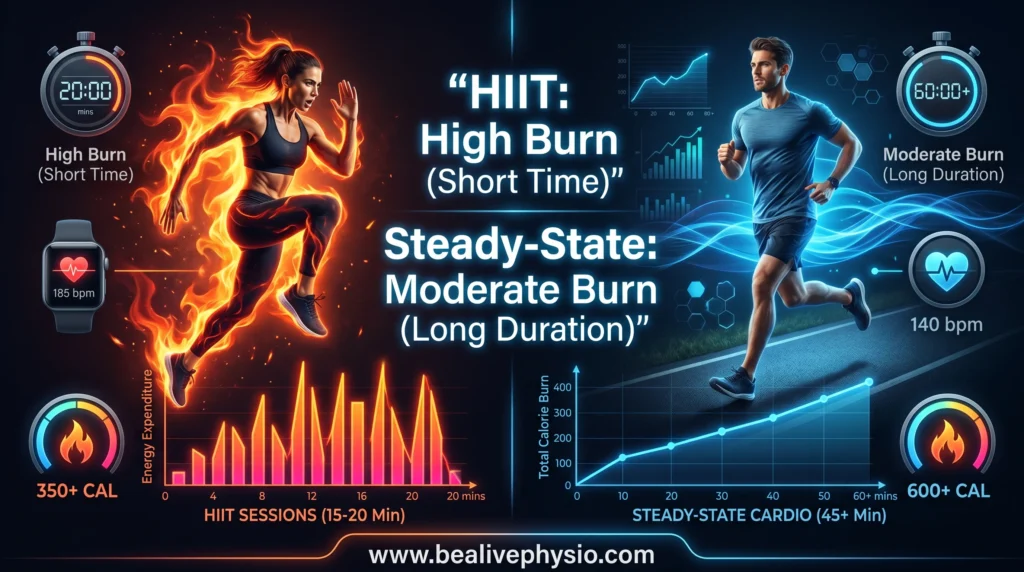
This is where things get interesting.
HIIT: Burns more calories per minute
HIIT can burn 20–30% more calories than SSC in a short period. But remember:
- It’s hard
- You can’t do it often
- Recovery is longer
So weekly calorie burn may not be as crazy as advertised.
Steady-State: Burns more calories overall
Most people can do steady-state 3–5 times a week—sometimes daily.
And consistency > intensity.
One 45-minute walk burns far more calories over a week than one 12-minute HIIT session.
What I observed with clients
- People who preferred steady-state typically lost weight more consistently.
- Those who used HIIT 2–3 days a week gained fitness faster and got leaner when paired with weight training.
- People who tried doing HIIT daily almost always burned out.
When You Should Use HIIT

HIIT is best used in strategic situations.
Use HIIT if you:
- Have limited workout time
- Want to improve VO2 max
- Enjoy fast, intense sessions
- Already lift weights and want extra calorie burn
- Are you preparing for sports or high-performance activities
Perfect examples
Busy professionals:
A client of mine, a software engineer, trained only 15 minutes during lunch using bike sprints—lost 5kg in 6 weeks without feeling exhausted all day.
Athletes:
HIIT helped sprinters and martial artists sharpen conditioning without long cardio sessions.
When You Should Use Steady-State Cardio

Steady-state is ideal for consistency and recovery.
Choose SSC if you:
- Are a beginner
- Are you overweight or returning from injury
- Want low-stress, easy-to-stick workouts
- Prefer longer, relaxing sessions
- Want to improve endurance
- Need recovery without taxing the body
Real examples
Weight-loss clients:
Most of my heavier clients improved faster with walking + light cycling. Their joints thanked them.
Those with stressful jobs:
Steady-state walks became their meditation time—improving mental health and fat loss simultaneously.
Combining HIIT and Steady-State (The Most Effective Approach)
You don’t need to choose one—smart programs combine both.
Here’s how I structure it for clients:
Weekly template
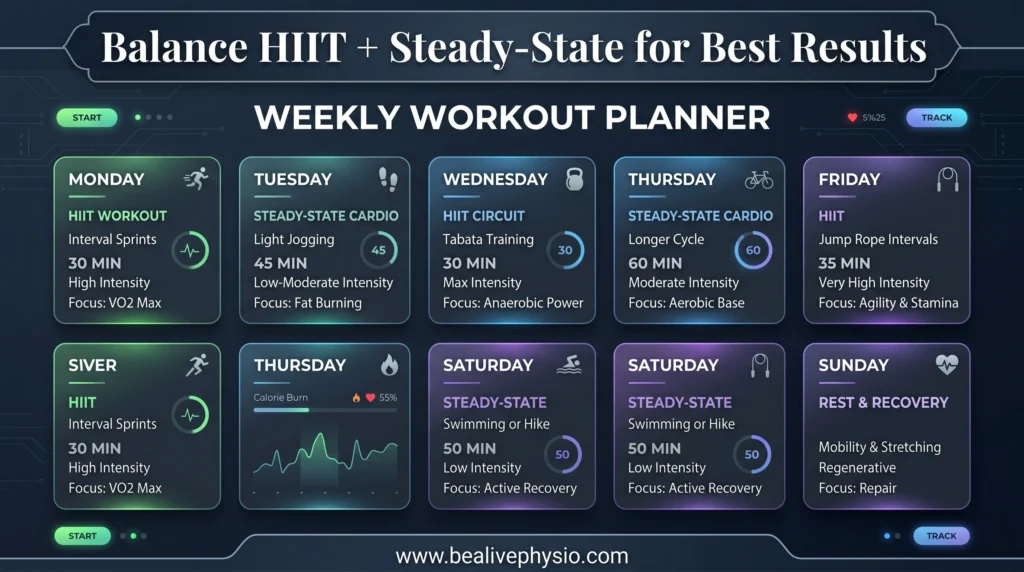
Option A: Fat Loss Focus
- Mon: Steady-state (45 min walk)
- Tue: HIIT (15 min bike)
- Thu: Steady-state
- Sat: HIIT or brisk walk
Option B: Endurance + Fat Loss
- Mon: Steady-state jog
- Wed: Interval running (HIIT)
- Fri: Steady-state cycling
Option C: Beginners
- 4–5 days walking
- 1 light HIIT day (optional)
Intensity rules I use
- If you slept poorly → choose steady-state
- If your legs feel heavy → steady-state
- If you feel energized → HIIT
- If you’re short on time → micro-HIIT (6–8 minutes)
Step-by-Step: How to Start HIIT Safely
Beginners often jump straight into burpees and box jumps. That’s how injuries happen.
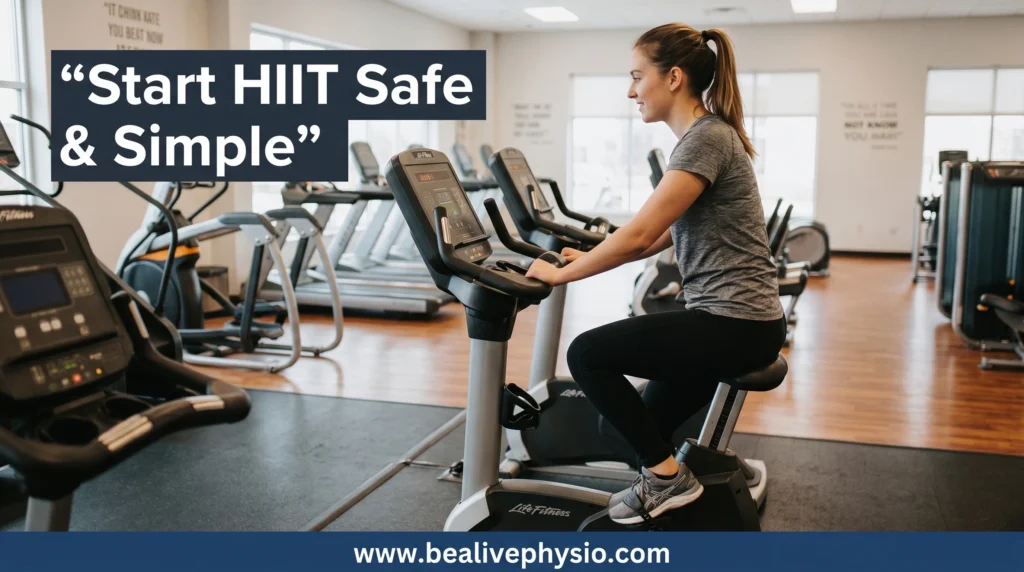
Step 1 — Choose a safe modality
(best for beginners and overweight users)
- Stationary bike
- Rower
- Walking incline treadmill
Step 2 — Use a simple 1:2 work-to-rest ratio
Example:
- 20 seconds fast
- 40 seconds slow
- Repeat 8–10 rounds
Step 3 — Keep sessions short
10–12 minutes is plenty.
Step 4 — Limit to twice a week
This prevents burnout.
Step-by-Step: How to Start Steady-State Cardio

Step 1 — Pick something sustainable
Walking is the easiest for most people.
Step 2 — Aim for 20–40 minutes
You don’t need more unless you’re training for endurance.
Step 3 — Track your heart rate
Most steady-state should be in Zone 2 (easy talk pace).
Fitness tools like:
- Polar H10
- Apple Watch
- Garmin Fenix
Step 4 — Add a little progress
Examples:
- Add 5 minutes every week
- Increase incline by 1%
- Add 1,000 extra steps daily
Frequently Asked Questions (FAQs)
Not always. HIIT burns more calories per minute, but steady-state can be done more often. The best fat-loss strategy mixes both.
Two to three times a week is ideal. Never daily.
Yes, but start with low-impact versions like bike sprints. Avoid jumping exercises at first.
Neither directly targets belly fat. However, HIIT can speed up metabolic rate, while steady-state supports long-term calorie burn.
Absolutely. Many clients lose significant weight through walking + strength training.
Do it after weights to preserve strength.
Final Thought

Both HIIT and steady-state cardio are powerful tools—just at different times and for different people. Instead of picking a side, match the method to your goals, energy levels, and lifestyle. When used strategically, the two together create a balanced, sustainable fitness routine that supports fat loss, endurance, and overall health without burning you out.