

If you’ve been training long enough—whether you lift weights, run, cycle, or follow home workout apps like Strong, Nike Training Club, or Fitbod—you eventually hit a wall. Not the “good soreness” wall, but the why-does-everything-feel-heavy wall.
I hit that same wall after months of consistent training, hitting PRs, and eating well. My numbers suddenly dipped, my sleep changed, and even warm-up sets felt like I was dragging bricks. That moment forced me to rethink something many people ignore: recovery is a skill, not a break.
This guide is the version I wish someone had handed me earlier—a practical, real-life map that explains rest days, deload weeks, and how to tell whether you should push harder or hit pause.
Why Recovery Isn’t Optional (Even If You Feel “Fine”)
Most people—even smart, disciplined lifters—treat recovery like an accessory.
But recovery doesn’t mean “no effort.” It means strategic effort.
When men and women skip recovery, here’s what I’ve personally seen happen:
- Strength stalls even with perfect programming
- Joints get cranky (elbows during push days, knees for runners)
- Sleep worsens, and motivation drops
- Workouts feel mentally heavier than physically
- Hunger and cravings spike
- Injuries suddenly appear “out of nowhere.”
Recovery isn’t what you do after training.
Recovery is what allows you to keep training.
What Rest Days Actually Do (Beyond Reducing Soreness)
Most people assume rest days are simply “days without the gym,” but they actually do far more.
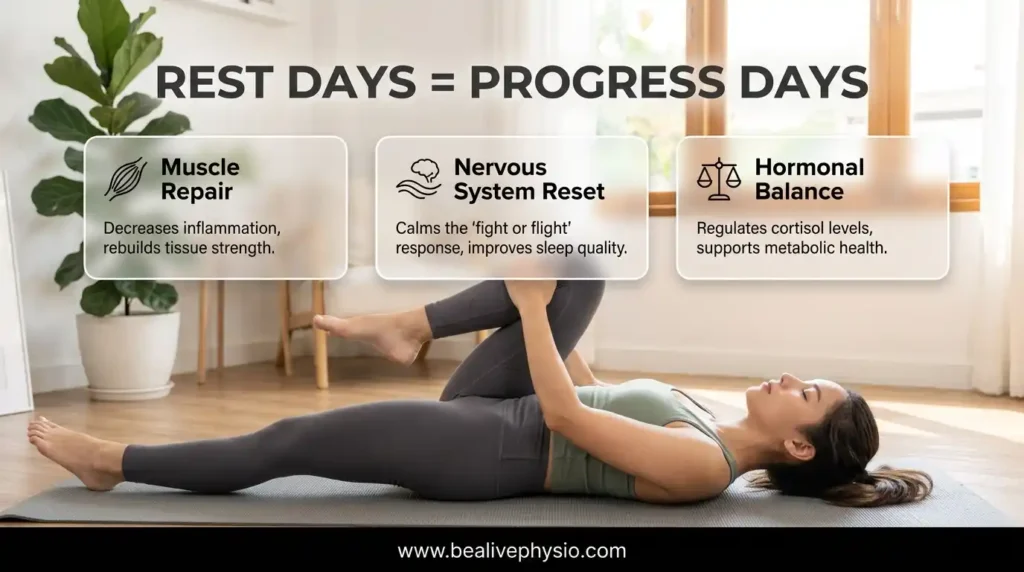
1. Recharge Neural Fatigue
Heavy lifting—especially compounds like squats or deadlifts—drains the central nervous system (CNS).
This isn’t soreness; it’s the tired feeling you can’t stretch away.
Real sign:
Your warm-up weights feel surprisingly heavy.
Rest days allow your CNS to reset so your “power output” returns to normal.
2. Rebuild Tissue, Not Tear It
Muscles don’t grow in the gym.
They grow after the gym when protein synthesis kicks in.
Rest days = better growth, better strength, better shape.
3. Fix Movement Issues in the Background
If your knee caves in during squats or your shoulder pinches during pressing, a rest day helps inflammation settle so your next session feels cleaner.
4. Reset Hormones and Stress Levels
Training constantly raises cortisol.
Rest resets the system.
Sleep improves, mood lifts, and cravings drop.
What a Proper Rest Day Should Look Like (Step-by-Step)
Here’s what actually works—not the Pinterest version of “self-care.”
Step 1 — Light movement instead of a complete shutdown
Examples:
- 20–30 min walk
- Light cycling
- Stretching or mobility
- Yoga via YouTube or the DownDog app
This improves blood flow without causing fatigue.
Step 2 — Prioritize protein
Aim for 0.7g – 1g per pound of body weight.
Protein fuels recovery.
Step 3 — Get one long exhale session
Stress delays recovery.
Use:
- Breathwork app
- Calm
- Headspace
5–7 min is enough.
Step 4 — Sleep 7–9 hours
Obsess over sleep.
No supplement replaces it.
Step 5 — Avoid comparing yourself to people who “never rest.”
Most of them are:
- New and not lifting heavy enough to require recovery
- Overtraining, but I don’t see it yet
- Posting highlights, not reality
When You Need a Deload Week (Not Just a Rest Day)
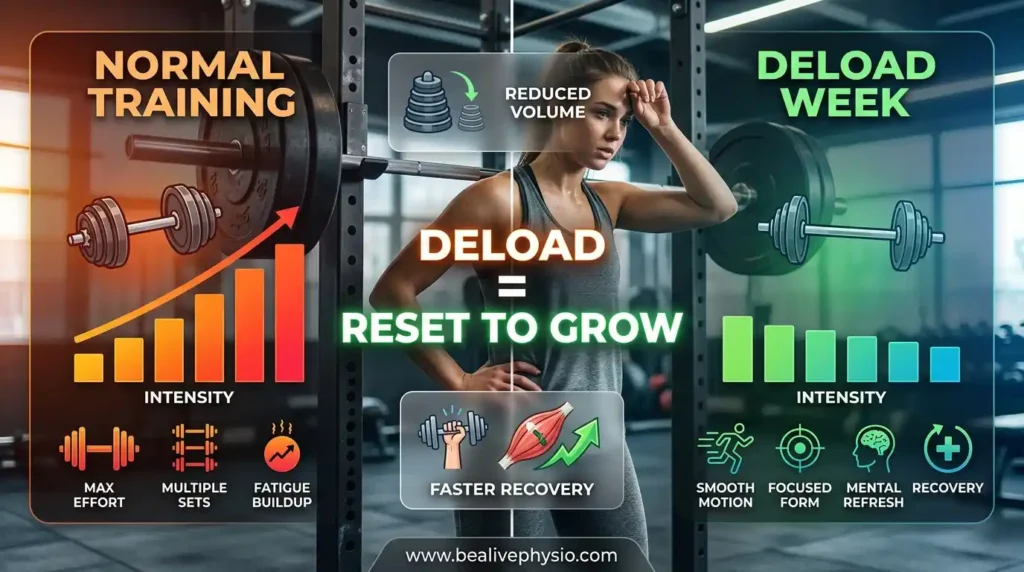
A deload week is not a vacation.
It’s a deliberate reduction in training volume or intensity so you can return stronger.
It’s usually ignored because it feels boring—but it’s one of the most useful tools for long-term gains.
Signs You Need a Deload Week
If you experience 3 or more of these, a deload is overdue:
- Everything feels heavier than it should
- Your sleep is worse, even with good habits
- Joints are achy or stiff
- The pump is weak
- Motivation is strangely low
- You get sick more often
- Strength stalls for more than 2–3 weeks
- Warm-ups feel like workouts
- Form breaks down more easily
Most people only deload when they’re forced to—after injury.
Smart lifters do it before the crash.
How to Run a Proper Deload Week
There are three main ways to deload. Choose the one that fits your personality:
1. Intensity Deload (Reduce Weight)
This is the simplest method.
You keep the same exercises but use 40–60% of your normal weight.
Example:
If you normally bench 80kg for reps, use 40–50kg.
Why it works:
Your body practices movement patterns without the heavy load.
2. Volume Deload (Fewer Sets)
Reduce:
- Sets by 50%
- Reps by 25–30%
Example:
- If you normally do 5 sets → do 2
- If you do 10–12 reps → do 6–8
Why it works:
Less workload means faster recovery while maintaining consistency.
3. Full Exercise Swap (My favorite method)
Swap major lifts with easier versions.
Examples:
- Squats → Leg press
- Deadlifts → Hip hinge machine or back extensions
- Barbell bench → Dumbbell bench
- Pull-ups → Lat pulldown
This reduces joint stress and gives your body a break without stopping training.
When to Push Through Fatigue vs. When to Pause

This is the part most people get wrong.
Fatigue is not always a stop sign.
But it’s not always a green light either.
Here’s the practical way to know the difference.
Push Through If the Fatigue Is…
- Mild soreness
- Lack of motivation
- A slow warm-up
- You slept poorly one night
- You’re mentally tired but physically fine
Fix with:
- Longer warm-up
- More hydration
- Pre-workout snack
- Lower expectations for the day

Hit Pause If the Fatigue Is…
- Sharp pain in joints
- “Bone-deep” tiredness
- Sleep has remained bad for over a week
- Loss of strength across multiple sessions
- Mood swings, irritability, or loss of appetite
- Elevated resting heart rate (use a smartwatch)
- Feeling sick or run-down
Use a smartwatch like:
- Garmin Forerunner
- Apple Watch
- Fitbit Charge
- Polar Vantage
These show HRV + recovery trends.
If HRV drops and resting HR goes up…
Your body is telling you to stop.
Common Mistakes People Make With Recovery
After training thousands of hours and coaching beginners to advanced athletes, these mistakes show up constantly:
1. Waiting for injury before taking recovery seriously
People train brilliantly—until they can’t.
2. Treating rest days as “cheat days.”
Junk food sabotages recovery.
Doing high-intensity “active recovery.”
If you’re sweating buckets, it’s not recovery.
4. Copying influencers who don’t show their rest
Nobody posts “rest day selfies.”
5. Thinking deloads make you lose progress
Deload weeks actually create the environment for progress.
My Personal Recovery Checklist (What Actually Works)
This is the exact routine that helped me consistently hit PRs without burnout:
- One full rest day per week
- One deload week every 6–8 weeks
- Sleep for a minimum of 7 hours
- Mobility twice per week
- 20 min low-intensity walking on off days
- Target protein + electrolytes
- Track morning HR and energy levels
This combination is what prevents that “burnout cliff” most lifters fall off.
FAQs (Frequently Asked Questions)
Most people need 1–2 rest days per week, depending on training intensity and age.
No. Deloads reduce fatigue and improve long-term gains.
A typical deload lasts 5–7 days.
Yes, but beginners often need it every 10–12 weeks, not 6–8.
Not always. Growth can happen without soreness.
Watch for drops in strength, bad sleep, low motivation, elevated resting heart rate, and persistent fatigue.
Not necessarily. Keep protein high. Slight calorie reduction is okay, but not required.
Final Thought

Recovery isn’t the opposite of training—it’s part of training.
The strongest, leanest, most consistent people aren’t the ones who grind nonstop.
They are the ones who know when to push, when to pause, and when to recharge.
If you apply rest days, deloads, and smart decision-making, your body responds with better strength, better shape, and better longevity in the gym.