
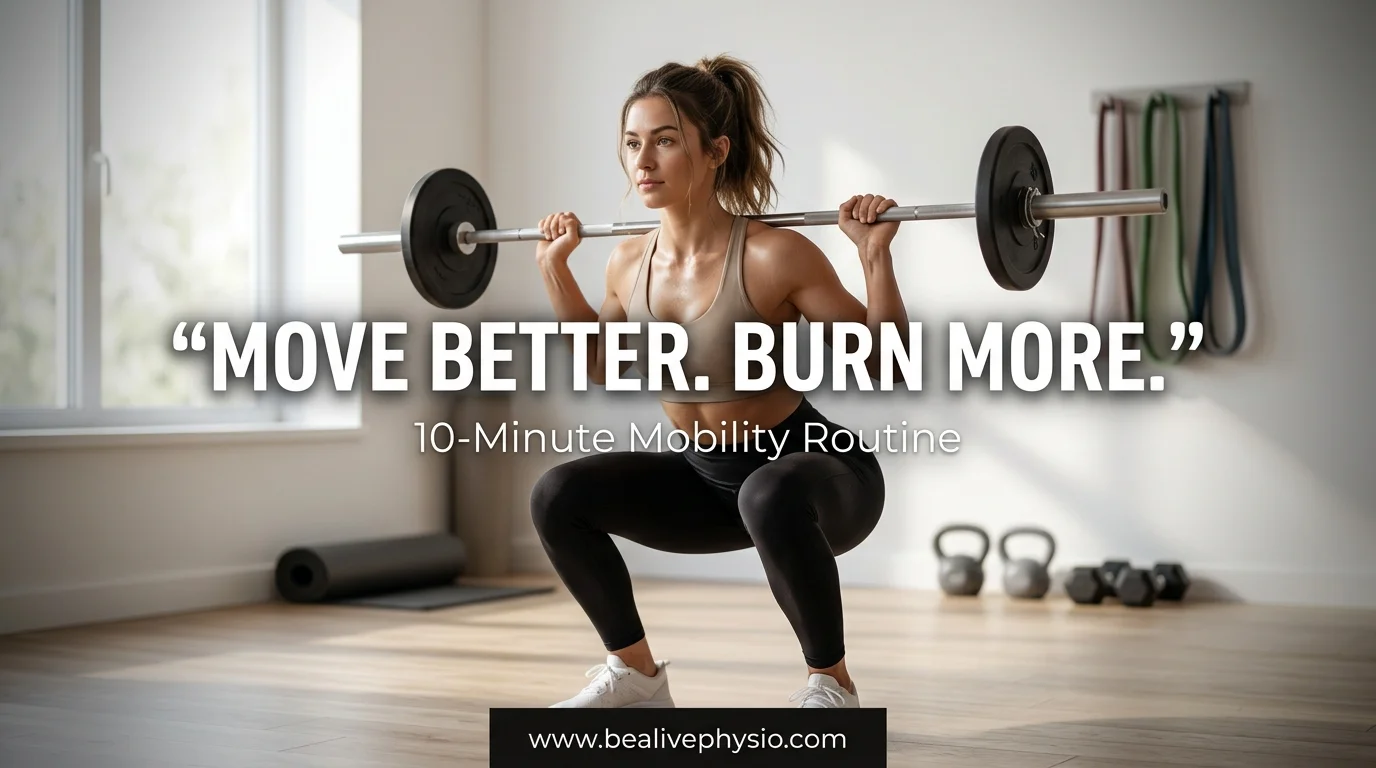
If you’ve ever felt stiff after sitting for hours or struggled to get into a proper squat without discomfort, you already know mobility isn’t just for athletes. It’s something I ignored for years while focusing only on strength and cardio. The result? Tight hips, sore shoulders, and workouts that felt harder than they should have.
Things changed when I started adding short, consistent mobility routines—just 10 minutes a day. Not only did my movement improve, but I also noticed something unexpected: I started burning more calories during workouts because my body moved more efficiently.
This guide walks you through practical, 10-minute routines you can actually stick to—no fancy equipment, no unrealistic promises.
Why Mobility Actually Impacts Fat Burn
Most people separate mobility and fat loss. That’s a mistake.
When your joints move freely:
- Your muscles activate better
- Your range of motion improves
- You engage more muscle fibers
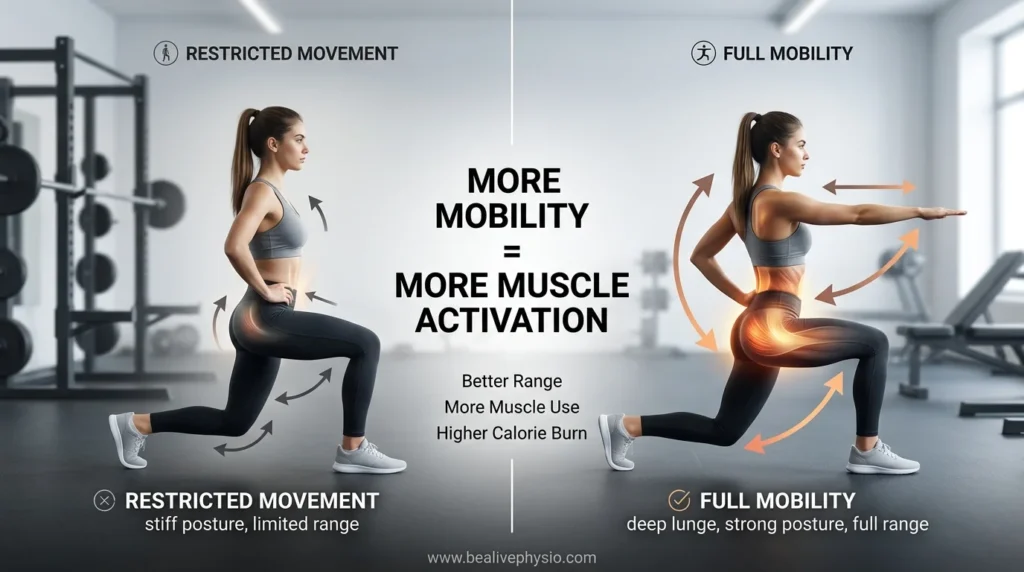
For example, a deep squat recruits glutes, hamstrings, and core far more than a half squat. That means more energy is used per rep.
A client I worked with (office worker, early 30s) couldn’t squat below parallel. After 3 weeks of mobility work, he improved depth—and his calorie burn during workouts increased noticeably, even without changing intensity.
Mobility isn’t just about flexibility—it’s about usable strength.
Common Mistakes That Kill Mobility Progress
Before jumping into routines, here are mistakes I’ve made (and see often):
1. Rushing Through Movements
Mobility isn’t a warm-up checkbox. If you’re flying through stretches, you’re wasting time.
2. Holding Static Stretches Only
Static stretching alone won’t improve movement quality. You need controlled motion.
3. Ignoring Pain Signals
Sharp discomfort isn’t “good stretch pain.” It’s your body telling you to stop or adjust.
4. Being Inconsistent
Doing 30 minutes once a week is far less effective than 10 minutes daily.
The 10-Minute Mobility Framework That Works
Instead of random stretches, I use a simple structure:
Minute 1–2: Joint prep
Minutes 3–6: Dynamic mobility
Minutes 7–10: Activation + flow
This keeps things efficient and prevents boredom.
Routine 1: Full-Body Morning Reset (10 Minutes)
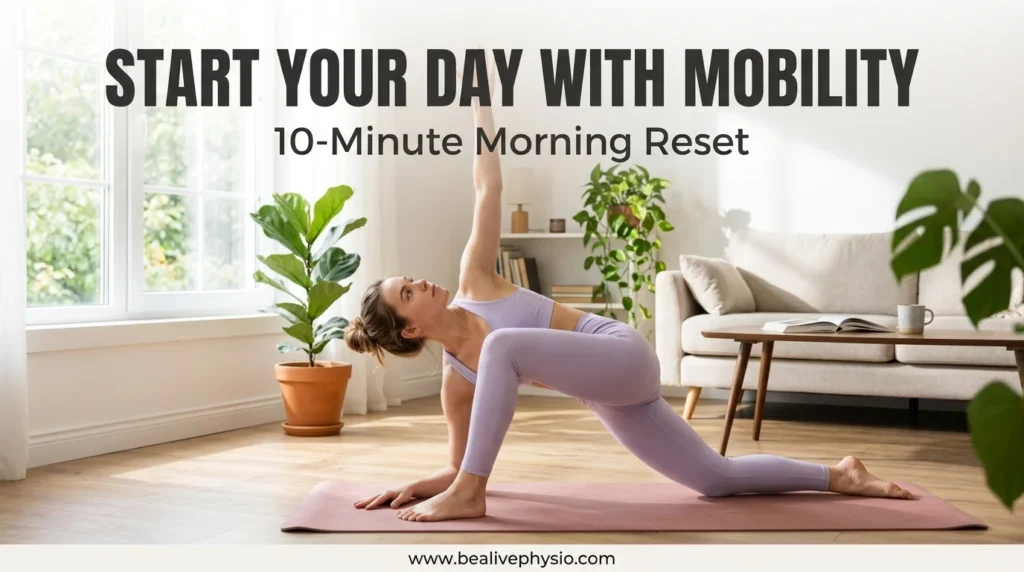
This is what I personally use on busy mornings.
Step-by-Step
1. Neck Rolls (1 minute)
- Slow circles, both directions
- Don’t force range
2. Arm Circles + Shoulder CARs (1 minute)
- Big controlled circles
- Focus on control, not speed
3. World’s Greatest Stretch (2 minutes)
- Step into a lunge
- Rotate torso toward the front knee
- Alternate sides
4. Deep Squat Hold with Reach (2 minutes)
- Sit in a deep squat
- Reach one arm up, then switch
- Keep heels grounded
5. Hip Flexor Pulses (2 minutes)
- Half-kneeling position
- Gently shift forward and back
6. Glute Bridges (1 minute)
- Squeeze at the top
- Slow reps
7. Cat-Cow Flow (1 minute)
- Move with breath
Real Result
After 2 weeks of doing this daily, my lower back tightness reduced significantly—especially after long desk sessions.
Routine 2: Desk Worker Mobility Fix
If you sit more than 6 hours a day, this one’s non-negotiable.
The Problem Areas
- Tight hip flexors
- Rounded shoulders
- Weak glutes
10-Minute Fix
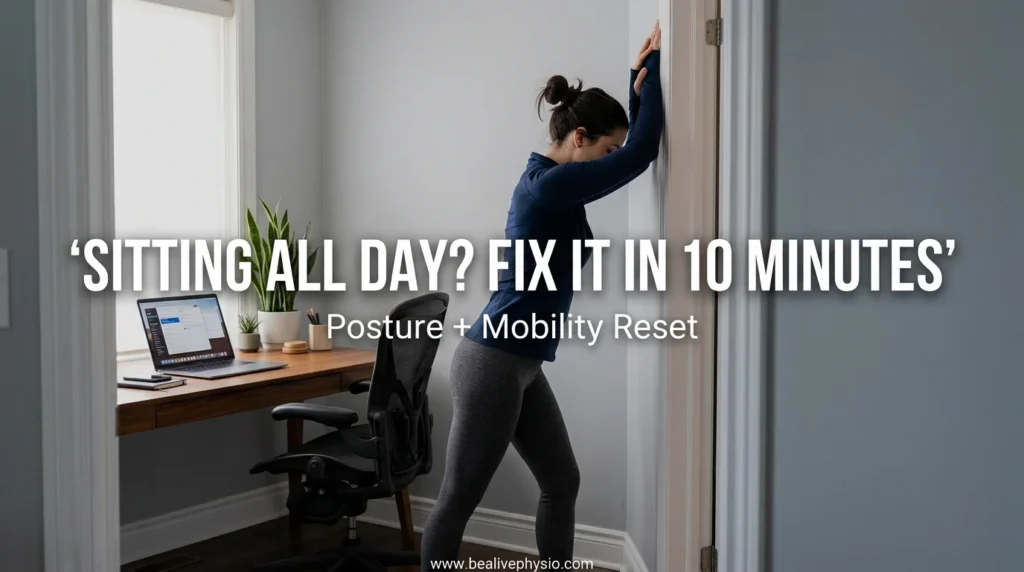
1. Thoracic Extensions (Chair or Wall) – 2 minutes
2. Doorway Chest Stretch – 1 minute
3. Seated Figure-4 Stretch – 2 minutes
4. Standing Hip Circles – 2 minutes
5. Wall Angels – 2 minutes
6. Bodyweight Squats – 1 minute
Tools That Help
- Resistance bands (light ones are enough)
- Foam roller (for thoracic spine)
- Yoga mat
These aren’t mandatory, but they make consistency easier.
Routine 3: Pre-Workout Mobility (Boost Performance + Burn)
This is where mobility directly impacts fat burn.

Why It Works
Better movement = better exercise form = more muscle engagement.
10-Minute Flow
1. Jump Rope or March in Place – 2 minutes
Gets blood flowing.
2. Hip Openers – 2 minutes
Lunges with rotation.
3. Ankle Mobility Rocks – 1 minute
Improves squat and running mechanics.
4. Inchworms – 2 minutes
Full-body activation.
5. Lateral Lunges – 2 minutes
Targets neglected movement patterns.
6. Plank Shoulder Taps – 1 minute
Core + shoulder stability.
Mistake I Learned the Hard Way
Skipping mobility before workouts led to:
- Poor squat depth
- Shoulder discomfort during pressing
Once I fixed this, lifts felt smoother and more controlled.
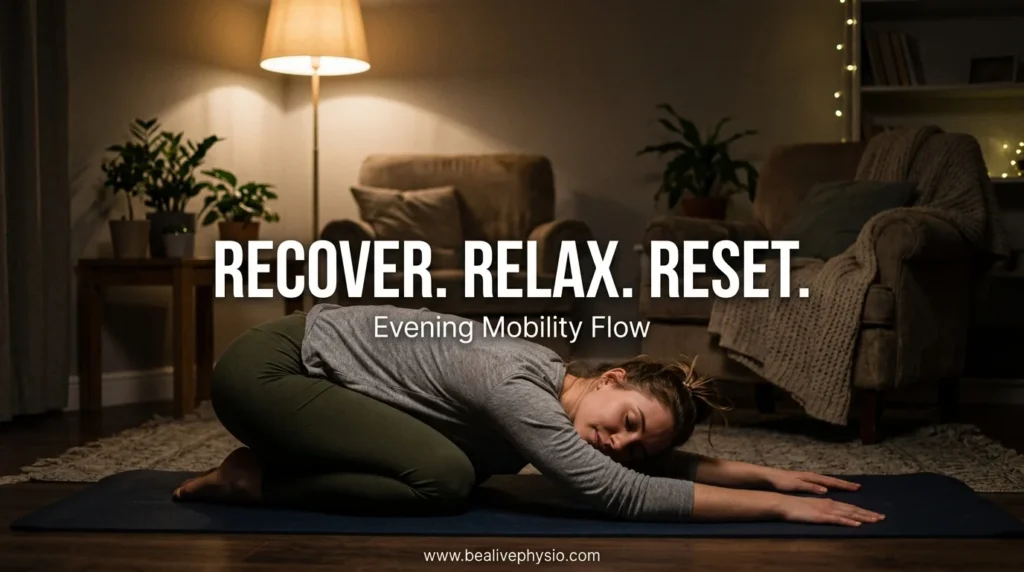
Routine 4: Evening Recovery Flow (Stress + Tightness Reset)
This one is underrated.
After a long day, your nervous system is tense. This routine helps with recovery and sleep.
Steps:
1. Breathing Reset (2 minutes)
- Inhale 4 seconds
- Exhale 6 seconds
2. Child’s Pose with Reach (2 minutes)
3. Supine Twist (2 minutes)
4. Hamstring Stretch (2 minutes)
5. Hip Internal Rotation Drill (2 minutes)
Real-World Benefit
Better sleep. And better recovery = better fat loss over time.
How Mobility Helps You Burn More (Without Extra Work)
Here’s what most people miss:
When your body moves efficiently:
- You recruit more muscle per movement
- You reduce energy leaks
- You sustain workouts longer
For example:
- A proper lunge engages the glutes fully
- A restricted lunge shifts stress to the knees
More muscle = higher energy expenditure.
Weekly Mobility Plan (Simple and Realistic)
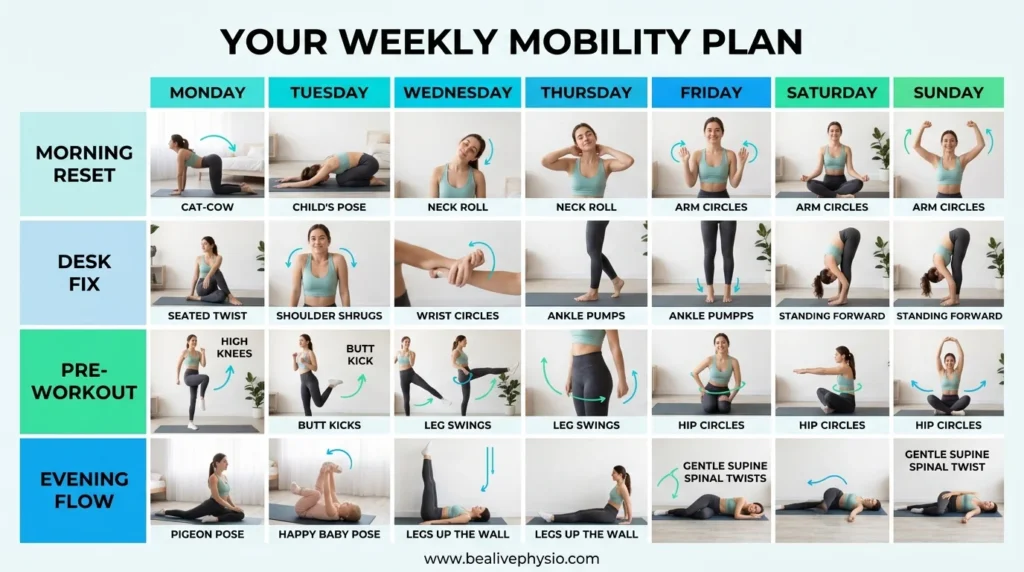
You don’t need to overcomplicate it:
- Morning Reset: 3–4 times/week
- Desk Fix: Daily (if you sit long hours)
- Pre-Workout: Before every workout
- Evening Flow: 2–3 times/week
This is sustainable. That’s what matters.
Scientific Backing (Simplified)
- A study published in the Journal of Strength and Conditioning Research shows that improved range of motion enhances muscular performance and efficiency.
- Research in Sports Medicine highlights that dynamic mobility improves movement quality and reduces injury risk.
- The American Council on Exercise (ACE) emphasizes mobility as a key factor in functional fitness and calorie expenditure.
Frequently Asked Questions (FAQs)
Yes—if done consistently. Daily short sessions outperform occasional long ones.
No. Mobility includes strength and control through movement, not just holding positions.
Morning, pre-workout, or evening—each serves a different purpose. The best time is the one you stick to.
No. Bodyweight works. Tools like bands or foam rollers are optional.
Indirectly, yes. It improves movement efficiency, which increases calorie burn during workouts.
Most people feel improvements in 1–2 weeks, especially in stiffness and movement ease.
Final Thoughts
Mobility doesn’t need to be complicated, long, or boring. Ten focused minutes a day can change how your body feels and performs.
The biggest shift for me wasn’t just less stiffness—it was moving with confidence again. Workouts became smoother, everyday tasks felt easier, and small aches stopped building up.
If you’re already training, mobility will amplify your results. If you’re not, it’s one of the easiest places to start.
Consistency beats intensity here—every single time.